

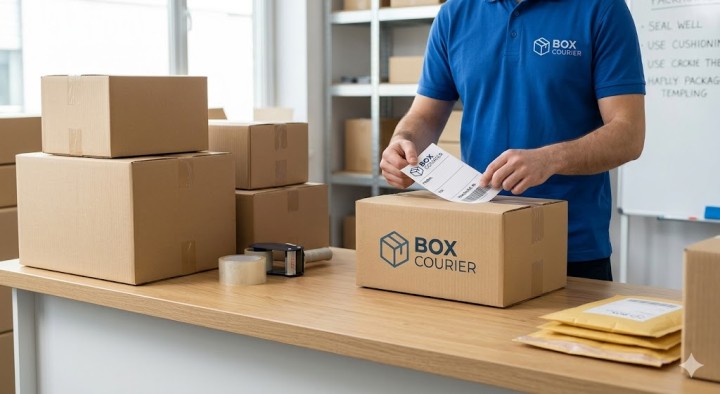
Do’s and Don’ts of Courier Packaging You Must Know
I didn’t always think much about packaging. Honestly, for the longest time, I assumed if a box looked neat and sealed properly, that was enough. Tape it, label it, hand it over, done. That was the system in my head. Until one small incident changed how I look at it.
I had sent a parcel to a friend, nothing expensive, just a few personal items. When it reached her, the outer box looked fine. Completely intact. That gave me a second of relief.
Then she opened it. Inside, things had clearly shifted. A couple of items had minor damage. Nothing dramatic, but enough to make one thing very clear: the problem wasn’t outside. It was inside the box.
That’s when it clicked. Packaging isn’t about how secure it looks from the outside. It’s about how stable everything stays when you’re not there to see what’s happening.
What actually happens after you send a package
We don’t really think about this part.
Once your parcel leaves your hands, it enters a system that’s fast, efficient, and, let’s be honest, not focused on your individual box. It gets grouped, moved, sorted, stacked, and transferred. Sometimes quickly. Sometimes repeatedly.
Your box might sit under heavier items. It might be shifted multiple times in a short span. It might be handled by different people across different points.
None of this is wrong. It’s just how the system works. But it means one thing. Your packaging has to assume movement.
The inside of the box matters more than the outside
This is where most people go slightly off. We focus on the box. The tape. The outer layer. But the real question is: what’s happening inside?
If there’s even a little space, items will move. And when they move, they come into contact with each other. Not once, but repeatedly.
That repeated contact is what causes most damage.
Not drops. Not accidents. Just movement. It’s subtle, but it adds up. There’s a small mindset shift that helps instead of asking, “Is this packed?” try asking, “Will this stay exactly where it is?” That one question changes how you pack.
You start noticing gaps. You think about weight. You pay attention to how items are positioned. And suddenly, the process becomes more intentional. Something I learned after a few trial-and-error moments
Not every item needs the same kind of attention. But most items need more than we initially give them.
I used to rely a lot on newspapers. Easy, available, quick. And it works, to a point. But on its own, it doesn’t stop movement. It softens impact slightly, but it doesn’t hold things in place. That’s where layering makes a difference.
Not in a complicated way. Just enough to prevent shifting.
Overpacking is one of those mistakes that feels right at first. You look at your items and think, “Let’s just fit everything into one box.” It saves time. Feels efficient.
But what actually happens is pressure builds inside. The box starts to push outward slightly. The structure weakens, even if you don’t notice it immediately. And once that happens, stability inside reduces.
Splitting items into two boxes doesn’t feel as convenient, but it usually works better.
Then there’s the issue of empty space
This one is easy to miss.
You close the box, shake it lightly, and think it’s fine.
But even small gaps matter.
Because movement doesn’t need a lot of space. It just needs enough. Filling those gaps doesn’t take much effort. But skipping it changes everything.
A situation I’ve seen more than once
A friend recently sent a mix of household items, some glass jars, a few utensils, and a small appliance.
She packed it herself. Carefully, in her own way.
But there was space inside. Not a lot. Just enough.
When the package arrived, a few things were damaged.
Later she said something simple: she should’ve checked with packers and movers instead of trying to manage everything alone. And that’s something I’ve heard multiple times.
Where professional help starts making sense
Not always. But sometimes.If you’re dealing with multiple items, fragile pieces, or anything that needs a bit more care, handling everything yourself can get tricky.
Professional packers and movers deal with this regularly. They know how to arrange, balance, and secure items in a way that reduces movement.
If you’ve searched for packers and movers near me, you’ve probably seen how many services are available. The best packers and movers usually include packaging as part of their service, which removes a lot of guesswork.
In courier-related situations, services like Box Courier come into the picture differently. I’ve seen people choose Box Courier not just for delivery, but because they don’t want to risk packaging mistakes. It’s less about speed, more about reliability.
In fact, Box Courier tends to be used in situations where items need that extra level of attention. Not every package, but the ones that matter.
And over time, I’ve noticed that people who use Box Courier regularly tend to approach packaging more thoughtfully as well. There’s less rushing, more planning. The part no one really talks about
Packaging takes longer than expected.
It’s repetitive. Slightly tiring. Easy to rush through. And that’s usually when things go wrong. You skip a layer. Ignore a gap. Assume it’ll be fine. That “it’ll be fine” moment is where most issues begin.
A few habits I’ve picked up (mostly from mistakes)
I don’t follow a strict system. But I do pause before sealing the box. Just to check if anything feels loose. Sometimes I reopen it. Fix something small. Close it again. It feels unnecessary at the moment. But later, it makes sense.
One last thought about choosing how to handle it
Not every situation needs professional help. But not every situation is simple either. Top packers and movers handle complex packaging. Services like Box Courier handle courier-specific needs where packaging plays a critical role.
If you’re already comparing packers and movers near me options, looking at something like Box Courier alongside them isn’t a bad idea. It just gives you more clarity on what fits your situation.
Final thought
Good packaging isn’t about doing something complicated. It’s about paying attention.
Taking a little extra time. Thinking one step ahead. Making sure things don’t move when you’re not there to fix them. Because once the package leaves your hands, that’s it. What you packed is what travels. And that’s what decides how it arrives.